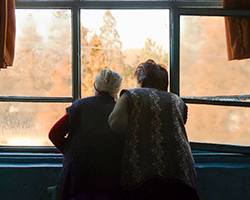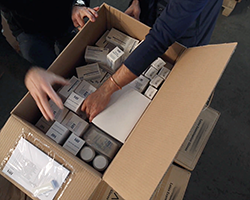
Copenhagen, 24 February 2022Amid the conflict rapidly unfolding in Ukraine, WHO/Europe reiterates its deepest concern for the safety, health and well-being of all civilians impacted by the crisis in the country and possibly beyond.As the United Nations Secretary-General has repeatedly warned, and as WHO/Europe echoes, any further escalation could result in a humanitarian catastrophe in…
Copenhagen, 22 February 2022WHO, along with other United Nations agencies, joins the United Nations Secretary-General in expressing its deepest concern over the escalating crisis in eastern Ukraine.The right to health is at the centre of humanitarian response. The WHO Country Office in Ukraine, together with the office of the United Nations Resident Coordinator in Ukraine…
Many thousands of lives could be saved each year in the WHO European Region, if Member States introduced more taxes on alcohol. Across the Region, taxes on the sale of alcohol are lower than taxes on tobacco. To enhance the untapped power of health taxes, the WHO Regional Director for Europe’s Advisory Council on Innovation…
As societies, we are failing to protect our children from the aggressive marketing of formula milk that can undermine their health, finds the new WHO–UNICEF global report titled “How marketing of formula milk influences our decisions on infant feeding”.According to the report, in every part of the world the formula milk industry – powered by…
Copenhagen, 22 February 2022WHO, along with other United Nations agencies, joins the United Nations Secretary-General in expressing its deepest concern over the escalating crisis in eastern Ukraine.The right to health is at the centre of humanitarian response. The WHO Country Office in Ukraine, together with the office of the United Nations Resident Coordinator in Ukraine…
How can countries best be supported to answer key policy questions relating to health and care workers? With just over a quarter of people in the WHO European Region living in rural or remote areas, how can strong, multidisciplinary teams be built to deliver primary health care based on local needs, as well as national…
As the ongoing COVID-19 pandemic has proven on a global scale, laboratories are central to any well functioning health system. Acting like a central nervous system, they help to detect and control outbreaks of diseases by identifying cases and sharing results. Given their crucial role in the health system, they need strong leadership.To train the…
While environmental risk factors account for at least 15% of mortality in the WHO European Region, inequalities in environmental exposure are making vulnerable groups more likely to be part of the 1.4 million deaths per year than others.To document and report on the magnitude of such inequalities within countries, WHO has launched the first 7…
Statement by Dr Hans Henri P. Kluge, WHO Regional Director for EuropeCopenhagen, 15 February 2022Across the entire WHO European Region, we have now recorded more than 165 million COVID-19 cases to date. This remains a deadly disease, 1.8 million people have lost their lives, 25 000 in the past week. Health systems are being put…
On International Childhood Cancer Day, 15 February 2022, WHO/Europe launched the report “Childhood cancer inequalities in the WHO European Region”. This report sets out for the first time the evidence on childhood cancer inequalities in the Region, and examines the patterns that emerge at national and regional levels of childhood cancer incidence, patient and caregiver…